
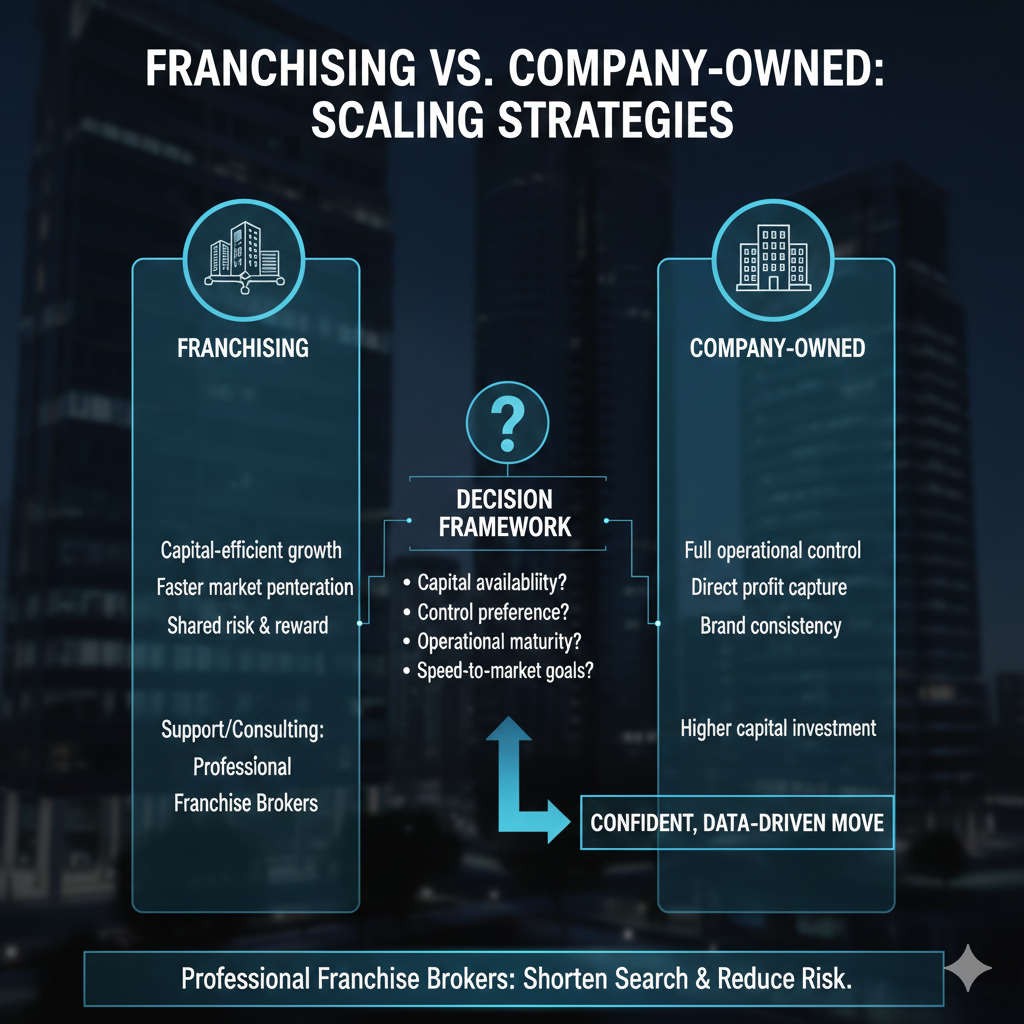
Deciding whether to scale through franchising or by opening more company-owned locations is one of the most consequential choices a growing brand will make. The right path depends on your capital, appetite for control, operational maturity, and goals for speed-to-market. This guide explains both options, offers a practical decision framework, and shows where a franchise consultant like Professional Franchise Brokers can help you make a confident, data-driven move.
What Franchising vs. Independent Expansion Really Means
- Franchising: You grant independent owners the right to operate under your brand in exchange for upfront fees and ongoing royalties. You provide training, standards, and support; they invest their own capital and operate day-to-day.
- Independent Expansion: You fund and run new company-owned units. You keep 100% of location-level profits and retain full control, but also carry all the build-out costs, payroll, and operating risk.
Pros and Cons at a Glance
- Franchising — Pros
- Faster geographic growth using franchisee capital
- Lower corporate balance-sheet risk per unit
- Royalty-driven, recurring revenue model
- Local owner-operators with strong community ties
- Franchising — Cons
- Reduced direct control over day-to-day operations
- Significant legal and compliance obligations (FDD, registrations)
- Ongoing support costs (training, field ops, marketing, tech)
- Brand risk if franchisees underperform or ignore standards
- Independent Expansion — Pros
- Full control of quality, pricing, and customer experience
- Keep 100% of unit economics and enterprise value
- Simpler legal/regulatory landscape than franchising
- Independent Expansion — Cons
- High capital requirements for each new location
- Slower scaling if cash or talent is constrained
- Concentration of risk on your P&L
Capital, Costs, and Unit Economics
- Franchising
- Revenue: Initial franchise fee (often $30k–$75k), ongoing royalty (typically 4%–8% of gross sales), brand fund contributions (1%–3%).
- Costs: Legal (FDD, state registrations), ops support (training, field visits), marketing, tech stack, franchise sales and lead generation.
- Independent
- Revenue: All unit-level profits accrue to corporate.
- Costs: Full build-out and working capital; more corporate hires for operations, HR, and management as you scale.
Rule of thumb: If your concept requires high per-unit CAPEX or complex corporate management, franchising can distribute risk and capital needs. If your units are very high-margin and easy to operate centrally, independent growth may yield greater long-term value.
Speed-to-Scale and Risk Profile
- Franchising can accelerate market penetration when you have replicable playbooks and strong demand across regions.
- Independent growth scales more predictably, but typically slower unless you have ample capital and leadership capacity.
- Franchising shifts some financial risk to franchisees, but increases compliance and brand-protection risk if selection or support is weak.
Legal and Compliance Snapshot
- United States: You must comply with the FTC Franchise Rule, prepare a Franchise Disclosure Document (FDD), and, in certain states, register before offering franchises.
- International: Master franchise or area development agreements add complexity (local laws, currency, supply chain, training localization).
Engage qualified franchise counsel early. A franchise consultant like Professional Franchise Brokers can coordinate legal, operations, and go-to-market workstreams to ensure you launch correctly the first time.
Operational Readiness Checklist
- Proven, profitable unit economics across multiple locations and markets
- Documented SOPs: hiring, training, service, inventory, safety, opening/closing
- Supply chain with national or regional coverage
- Technology stack (POS/CRM, reporting, support portal)
- Brand standards and QA processes
- Training curriculum and certification for owners/managers
- Lead-gen and marketing playbooks (local + national)
- Field support structure (coaches, onboarding, site selection)
- Compliance calendar (FDD updates, state renewals, ad fund governance)
- Executive capacity to support 10–50+ units in the next 24–36 months
Marketing Implications: Capture Demand Where It Lives
Franchisors must win attention from candidates searching phrases like how to buy a franchise, low-cost franchise opportunities, and best franchises for 2026. Plan for:
- SEO landing pages that explain investment, training, and earnings potential (with proper earnings claims compliance)
- Listings on franchise portals and curated rankings (aim to appear in “best franchises for 2026” roundups)
- Content that educates buyers on how to buy a franchise, funding options, and validation calls
- Paid media and PR to build brand credibility beyond your core market
Tip: If your total investment is competitive, position your concept among credible low-cost franchise opportunities to widen your candidate pool.
When Independent Expansion Is the Better Bet
- Quality control is existential (premium hospitality, medical services, niche manufacturing)
- High proprietary know-how that’s hard to codify or protect
- Strong access to capital or patient investors
- Limited market footprint goals or deep density strategy in one region
When Franchising Is the Better Bet
- Simple, repeatable operations with strong unit economics
- Broad, multi-market demand with local owner-operator advantages
- Moderate build-out costs and short ramp to break-even
- Willingness to invest in training, field support, and compliance
Hybrid Paths Worth Considering
- Company-owned flagships in core markets, franchised units elsewhere
- Area developers or multi-unit franchisees to concentrate regional growth
- Joint ventures with top operators for complex or strategic markets
A 10-Step Decision Framework
- Define 3-year goals for revenue, markets, and unit count.
- Model unit economics (AUV, COGS, labor, rent, EBITDA) and sensitivity scenarios.
- Compare capital needs and returns for 10 new units: all-corporate vs. franchise system with royalties and fees.
- Assess operational readiness against the checklist above.
- Audit brand moat: IP, differentiation, and pricing power.
- Map compliance timeline and legal budget for franchising.
- Estimate franchise candidate acquisition cost and funnel metrics.
- Pressure-test supply chain and training at scale.
- Conduct candid risk review: control, reputational, and execution risks.
- Make a go/no-go decision with an independent feasibility review.
Need a neutral, numbers-first perspective? Book a feasibility assessment with Professional Franchise Brokers to compare scenarios and validate your go-to-market plan.
FAQs
- How long does it take to launch a franchise? Typically 4–8 months for legal, operations, and marketing readiness.
- What does it cost to franchise my business? Commonly $75k–$200k+ to develop legal documents, manuals, and marketing; ongoing support costs scale with the system.
- What royalty is typical? Many concepts range 4%–8% of gross sales; service brands may be higher. Also plan for a 1%–3% brand fund.
- How many company units do I need first? Validation is easier with 2–3+ proven units across varied markets, though some brands franchise with one exceptional prototype.
- International right away? Usually no—prove national fit first, then consider master franchise deals with robust support.
Next Steps
If you’re weighing franchising vs. corporate expansion, don’t guess—model it. Align your capital plan, operations, and marketing with your growth goals. Then decide with confidence.
- Request a free feasibility review from Professional Franchise Brokers
- Get introductions to franchise attorneys, FDD writers, and funding partners
- Build a compliant “how to buy a franchise” funnel and candidate journey
Ready to explore whether franchising, independent growth, or a hybrid is right for you? Contact Professional Franchise Brokers to accelerate a smart, scalable expansion strategy—and position your brand to compete for “best franchises for 2026” while protecting your unit economics and your brand.