
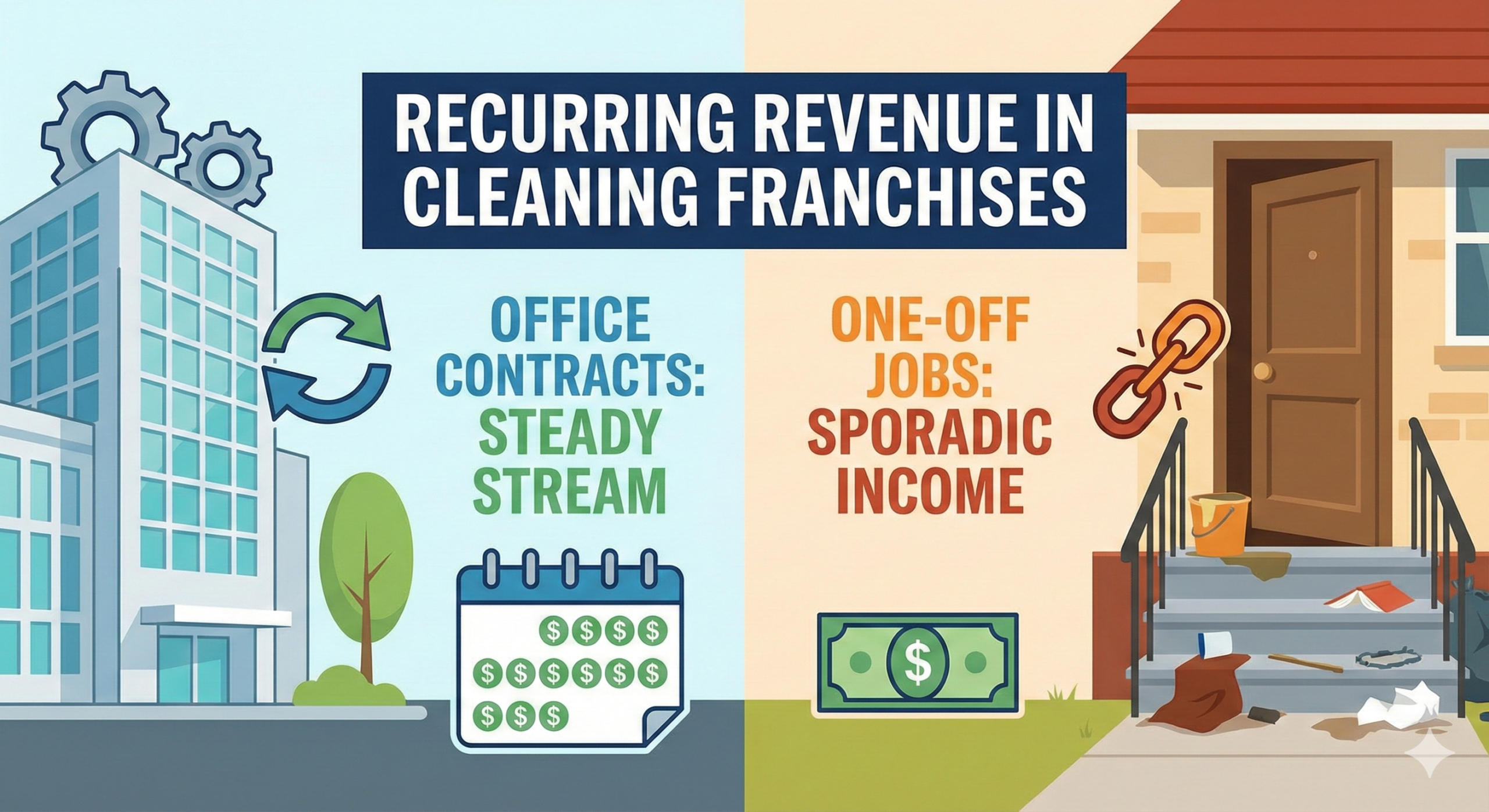
Recurring revenue is the heartbeat of many cleaning franchises. For new and experienced investors evaluating low-cost franchise opportunities, the choice between securing ongoing office contracts or focusing on one-off jobs can define profitability, workload, and scalability. This guide breaks down both models, shows how they impact cash flow and valuation, and explains how to buy a franchise strategically—with tips tailored to commercial and residential cleaning brands.
What “Recurring Revenue” Means in Cleaning Franchises
Recurring revenue comes from scheduled services performed weekly, bi-weekly, or nightly. In cleaning, that often includes:
- Commercial janitorial contracts (offices, medical, education, light industrial)
- Day porter services and routine floor care
- Residential maintenance cleanings on a set cadence
By contrast, one-off project work includes move-in/move-out cleaning, post-construction, deep cleans, and restoration-adjacent services.
Office Contracts: The Recurring-Revenue Engine
Office or commercial contracts lean into predictability. Many franchisees use these accounts to stabilize labor and cash flow, then layer upsells for margins.
- Predictable schedules: Nights or early mornings with steady routing.
- Contract terms and renewals: Expect multi-month or multi-year agreements with renewal provisions and service-level expectations.
- Higher client lifetime value: Each client can represent months or years of revenue when service is consistent.
- Operational rhythm: Easier crew utilization and route density; more consistent payroll planning.
- Upsell potential: Carpets, windows, disinfection, floor strip-and-wax, higher-frequency day porters.
Considerations:
- More procurement-driven: Bidding, proposals, and Facilities/Property Manager relationships matter.
- Quality control is essential: Missed QA can risk entire contracts.
- Accounts receivable: Payment cycles can be longer; watch cash-flow timing.
One-Off Jobs: Flexible, Fast, and Often Higher Ticket
Project-based cleaning can command premium pricing and respond to urgent demand spikes.
- Higher average job values and surge pricing during peak moves or post-construction timelines.
- Marketing-driven: PPC, local SEO, referral partners (REALTORS, contractors, property managers).
- Rapid cash: Often faster invoicing and payment cycles than B2B contracts.
Considerations:
- Revenue volatility: Demand is seasonal and event-driven.
- Scheduling friction: Crew utilization varies; overtime risk in peak weeks.
- Lead generation costs: Continuous ad spend and review management required.
Financial Model: Recurring vs. One-Off
A practical way to compare is through CAC, retention, and lifetime value:
- CAC (Customer Acquisition Cost): B2B contracts may cost more to win but pay over a longer period; one-off CAC can be lower but must be paid repeatedly.
- LTV (Lifetime Value): Recurring contracts typically yield higher LTV due to longer relationships and add-ons.
- Cash flow: One-off work can provide quick boosts; recurring work offers stability and better forecasting.
- Valuation: Buyers and lenders often favor predictable MRR/ARR from contracts.
Key KPIs to Track (for Either Strategy)
- Monthly Recurring Revenue (MRR) vs. Project Revenue
- Client Concentration (top 5 accounts as % of revenue)
- Churn and Renewal Rates for contracts
- Average Ticket and Gross Margin by service line
- Route Density and Technician Utilization
- Days Sales Outstanding (AR) and Cash Conversion Cycle
- First-Time-Right Rate and Rework Percentage
Sales and Marketing Differences
- Office contracts: Local B2B networking, proposals/RFPs, facility manager outreach, reputation via Google Business Profile and B2B reviews.
- One-off jobs: SEO for “move-out cleaning,” “post-construction cleaning,” paid search, marketplace listings, and tight phone/CRM response times.
Operations and Staffing
- Recurring: Stable night crews, standardized SOPs, predictable inventory (chemicals, consumables).
- One-off: Flexible staffing, specialty equipment readiness, rapid scheduling, and strong job costing.
Risk, Contracts, and Compliance
- Review service levels, termination clauses, and indemnification in B2B contracts.
- Ensure insurance coverage (GL, workers’ comp; additional insured for commercial clients).
- Build redundancy so a single lost account doesn’t destabilize revenue.
Best Fit by Owner Profile
- Choose office contracts if you want: Predictable schedules, scalable route density, higher LTV, repeatable SOPs.
- Choose one-off jobs if you want: Faster cash, sales energy, specialization (e.g., post-construction), and flexible operations.
- Hybrid approach: Anchor the business with recurring contracts and fill downtimes with high-margin projects.
How to Buy a Franchise: Step-by-Step for Cleaning Brands
- Clarify your goals: recurring stability vs. rapid growth spikes; owner-operator or semi-absentee.
- Shortlist brands: Compare territories, training, technology, and unit-level economics.
- Request and study the FDD: Focus on Item 7 (startup costs), Item 19 (financial performance), royalties, and marketing fund fees.
- Validate with franchisees: Ask about acquisition channels, average contract size, churn, route density, and staffing.
- Model finances: Create conservative scenarios for MRR, project work, payroll, and AR timing.
- Assess territory demographics: Office density vs. new construction, multifamily turnover, and commercial mix.
- Plan staffing: Hiring pipelines, background checks, and QA processes.
- Secure funding: SBA, ROBS, or equipment financing; confirm working capital for 6–12 months.
- Negotiate and sign: Understand training, launch support, CRM, bidding software, and national accounts access.
- Execute a 90-day launch plan: Lead gen, referral partners, and a renewal-focused operations cadence.
Need help navigating how to buy a franchise? A franchise consultant like Professional Franchise Brokers can help you compare brands, check territories, and model financing options.
Evaluating Low-Cost Franchise Opportunities in Cleaning
- Startup investment vs. breakeven timeline and cash-flow needs
- Strength of commercial account support (bidding tools, national accounts)
- Local marketing playbook for one-off jobs (SEO, PPC, reviews)
- Technology stack: CRM, job costing, route optimization, QA apps
- Training depth: sales, operations, compliance, and safety
Cleaning brands are often among the more low-cost franchise opportunities relative to food or retail, making them attractive to first-time buyers and multi-unit operators seeking service diversification.
Positioning for the Best Franchises for 2026
As you shortlist the best franchises for 2026, prioritize brands that:
- Offer a balanced mix of recurring commercial contracts and high-margin project work
- Provide proven lead-gen frameworks and national account introductions
- Publish transparent unit economics and robust Item 19 data
- Support multi-territory scaling and labor efficiency
Before committing capital, talk with multiple current franchisees and test assumptions with your own pro forma. A seasoned franchise consultant like Professional Franchise Brokers can accelerate this process and reduce blind spots.
Questions to Ask Any Cleaning Franchisor
- What percentage of revenue is recurring vs. one-off at maturity?
- Average contract length and renewal rate?
- Typical AR cycle and how it affects working capital?
- Lead sources that drive the most profitable jobs in my territory?
- Crew retention strategies and QA processes that protect renewals?
- Protected territory specifics and expansion options?
Action Plan: Turn Insights into Revenue
- Pick your core: recurring contracts, one-off projects, or a hybrid—and align hiring and marketing accordingly.
- Build routing density or a specialty niche for competitive defensibility.
- Track KPIs weekly: utilization, churn/renewals, AR, and margin by service line.
- Schedule quarterly client business reviews for contract upsells and retention.
Ready to compare brands and map your path to predictable revenue? Speak with Professional Franchise Brokers for unbiased guidance on selection, funding, and launch execution.