
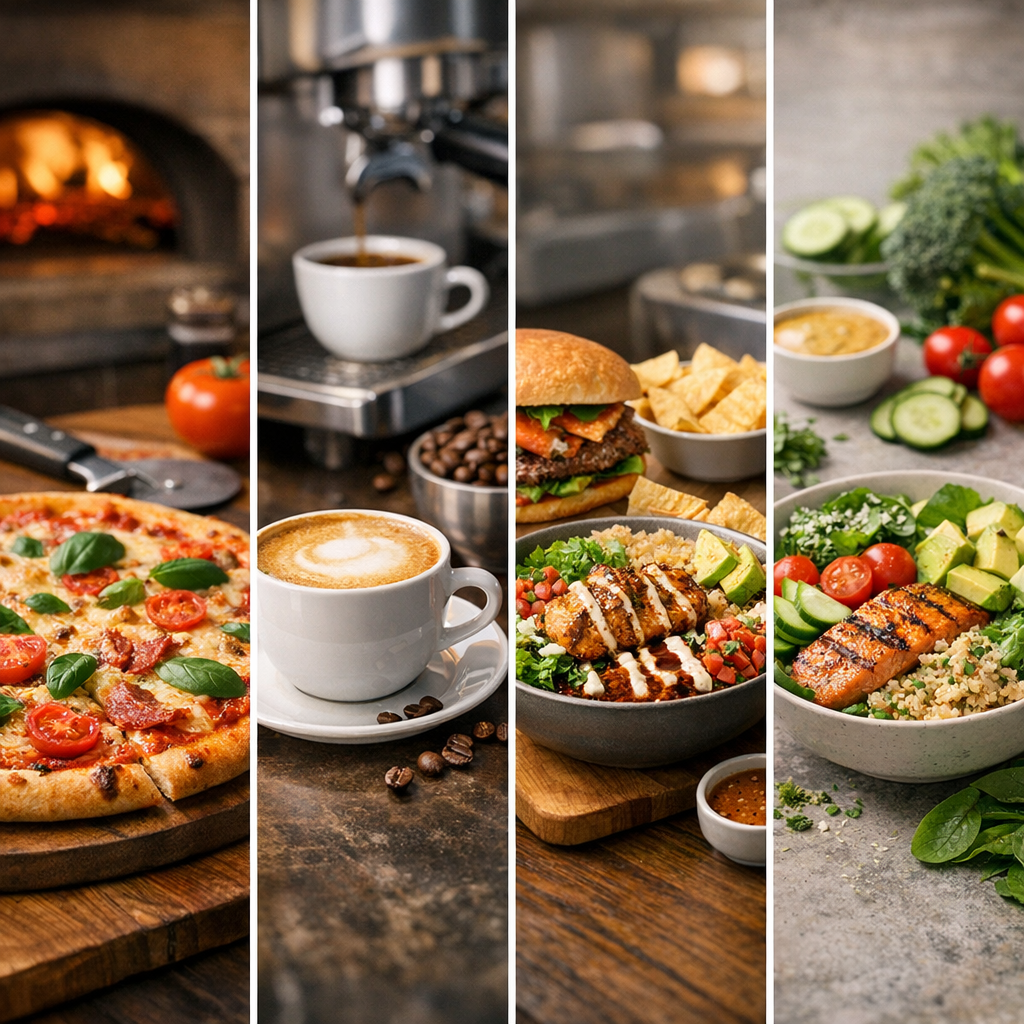
Quick comparison: Pizza excels at delivery-driven scale; Coffee wins on daily repeat traffic and smaller footprints; Fast Casual maximizes average check with operational complexity; Healthy Eats taps wellness trends with flexible real estate and lower build-outs. Your best path depends on budget, labor tolerance, and daypart strategy—see below for step-by-step guidance on how to buy a franchise and choose among cuisine models.
TL;DR — Which cuisine fits your goals?
- Pizza: Best for delivery/digital scale and multi-unit expansion. Moderate-to-high build-out; consistent dinner sales; strong catering potential.
- Coffee: Best for daily repeat visits and simpler ops. Smaller footprint, lower labor per transaction, strong morning daypart, drive-thru optional.
- Fast Casual: Best for higher average ticket and broad menus (bowls, burritos, chicken, burgers). Strong lunch/dinner, but more SKUs and prep complexity.
- Healthy Eats: Best for wellness brand positioning and flexible sites (inline, urban, non-traditional). Lower equipment costs; marketing must educate and retain.
How to buy a franchise (6-step, investor-ready plan)
- Define budget, timeline, and role (owner-operator vs semi-absentee). Stress-test cash and working capital.
- Shortlist brands by cuisine and goals. Start with our guide: How to Buy a Franchise.
- Request FDDs; scrutinize Items 7, 19, and 20 for investment, performance disclosures, and system stability.
- Validate with 5–10 franchisees across performance quartiles; confirm labor, COGS, and marketing realities.
- Secure territory, financing (SBA 7(a) or 504), and a site with LOI contingencies; negotiate tenant allowances.
- Build opening plan: permitting, GC bids, pre-opening marketing, hiring, training, and POS/integrations.
Tip: Engage a specialist. A seasoned consultant like Professional Franchise Brokers can match brands, analyze FDDs, and negotiate better terms.
Pizza franchises — model at a glance
Answer first: Choose pizza if you want delivery-first revenue, strong dinner profits, and scalable multi-unit operations.
- Typical investment: roughly $250,000–$2,000,000+ (counter-service to full-service; verify FDD Item 7).
- Footprint: 1,200–3,000+ sq ft; high utility for delivery/carryout; dine-in optional by brand.
- Revenue mix: Delivery/carryout heavy; third-party marketplaces common—watch fee structure and data ownership.
- Labor/COGS: Dough, cheese, and protein volatility; batch prep helps margins; cross-trained staff critical.
- Equipment: Ovens (conveyor/deck), mixers, make-lines; maintenance matters for peak throughput.
- Marketing: Local SEO, app/loyalty, SMS offers; gameday/party bundles drive spikes.
- Pros: High repeat ordering; scalable production; strong off-premise; catering upsides.
- Watch-outs: Driver staffing, aggregator fees, cheese price shocks, and delivery radius limits.
- Best for: Operators planning multi-unit clusters to optimize labor, marketing, and commissary prep.
Coffee shop franchises — model at a glance
Answer first: Choose coffee if you want daily habit traffic, smaller buildouts, and simpler menus with strong loyalty economics.
- Typical investment: roughly $250,000–$1,500,000 (kiosk/inline vs drive-thru; espresso equipment drives capex).
- Footprint: 600–1,800 sq ft inline; 0.3–0.6 acre pad for drive-thru sites.
- Revenue mix: Beverage-led; pastries/light food add-on; morning peak with secondary afternoon bump.
- Labor/COGS: Low food waste; barista training impacts speed-of-service; dairy/alt-milk costs notable.
- Tech: Loyalty and mobile order are mission-critical for repeat frequency and line-busting.
- Pros: High frequency, smaller staff, predictable ordering patterns, brand love.
- Watch-outs: Site saturation risk near anchors, weather sensitivity for walk-up stores, drive-thru permitting.
- Best for: Operators favoring customer experience, loyalty-building, and speed over complex kitchens.
Fast Casual (burrito, bowl, chicken, burger) — model at a glance
Answer first: Choose fast casual if you want larger checks, robust lunch/dinner traffic, and brand-building potential—with more SKUs and ops.
- Typical investment: roughly $500,000–$2,500,000+ depending on hooded kitchen, drive-thru/pickup lanes, and seating.
- Footprint: 1,800–3,200+ sq ft; strong lunch/dinner; catering potential for offices and events.
- Labor/COGS: More prep, hot line/hood; food safety and throughput discipline essential.
- Delivery: Incremental sales, but packaging and food-hold quality can impact reviews.
- Pros: Big brand upside, strong AUV potential, menu innovation levers, family occasions.
- Watch-outs: Higher build-out and rents, complex training, food inflation exposure.
- Best for: Experienced operators, strong managers, and multi-unit growth plans.
Healthy Eats (salads, bowls, smoothies) — model at a glance
Answer first: Choose healthy eats if you want wellness positioning, flexible sites, and lower equipment loads—marketing must drive education and retention.
- Typical investment: roughly $200,000–$750,000 (many concepts avoid hoods; cold line and blenders common).
- Footprint: 800–1,800 sq ft; urban business districts, fitness adjacencies, universities, hospitals.
- Labor/COGS: Produce-heavy with shelf-life management; strong prep SOPs reduce waste.
- Dayparts: Lunch strong; breakfast if smoothies/juices; subscriptions and cleanse programs optional.
- Pros: Trend tailwinds (health, flexitarian), faster openings with lighter MEP, compelling brand storytelling.
- Watch-outs: Produce pricing, seasonality, need for sophisticated CRM to sustain repeat visits.
- Best for: Marketers and community builders, first-time franchisees seeking simpler equipment.
Cost and unit-economics snapshot (verify in each brand’s FDD)
- Initial investment (typical ranges):
- Healthy Eats: ~$200k–$750k
- Coffee: ~$250k–$1.5M (drive-thru pushes higher)
- Pizza: ~$250k–$2.0M+
- Fast Casual: ~$500k–$2.5M+
- Operating complexity (low to high): Coffee / Healthy Eats → Pizza → Fast Casual
- Off-premise reliance (low to high): Coffee (varies by drive-thru) → Healthy Eats → Fast Casual → Pizza
- Labor intensity (low to high): Coffee → Healthy Eats → Pizza → Fast Casual
Note: Actual profitability varies by location, execution, and brand. Review FDD Item 19, validate with owners, and model conservative scenarios.
Low-cost franchise opportunities
Searching for low-cost franchise opportunities? Start with lighter-build models (kiosks, inline stores without hoods) and strong landlord TI packages. Explore our guide: Low-Cost Franchise Opportunities.
- Kiosks and non-traditional venues (hospitals, universities).
- Healthy Eats concepts without cooking hoods.
- Coffee carts and drive-thru-only sheds (site-dependent).
- Pizza carryout-only formats in second-generation spaces.
Best franchises for 2026 — what to watch
Instead of chasing hype, evaluate fundamentals. Our annual watchlist covers brands with disciplined growth, transparent FDDs, and strong unit economics: Best Franchises for 2026.
- Evidence of comp sales growth beyond price increases.
- Sane real estate strategy (drive-thru where justified, pickup shelves elsewhere).
- Technology stack that reduces labor and improves throughput.
- Supply chain leverage and hedging strategies.
Multi-unit vs single-unit strategy
- Pizza/Fast Casual: Plan territories in clusters to share managers, marketing, and prep.
- Coffee/Healthy Eats: Consider a hub-and-spoke around morning or fitness demand pockets.
- Open cadence: Stagger 6–9 months apart to stabilize labor and cash flow.
Site selection and territory tips
- Match cuisine to daypart drivers: offices/schools for lunch; rooftops and easy access for dinner/delivery.
- Prioritize parking, ingress/egress, and visibility. For coffee: drive-thru queue capacity and traffic counts.
- Use data: mobile location analytics, trade-area studies, and cannibalization modeling.
- Negotiate: free rent, TI allowances, and kick-out clauses tied to permits/drive-thru approval.
Operations tech stack (non-negotiables)
- POS + KDS with native delivery integrations and modifier handling.
- First-party loyalty, CRM, and push/SMS for reactivation and frequency.
- Inventory and prep planning to curb waste (produce/pizza cheese tracking).
- Scheduling with forecasted sales and labor optimization.
Legal and financial diligence
- FDD Items 5–7: Fees and total investment (include working capital and soft costs).
- Item 19: Performance claims—understand medians vs averages; ask for cohort performance if available.
- Item 20: System growth and closures; litigation disclosures in Item 3.
- Lease: Personal guarantees, assignment, exclusives, co-tenancy clauses.
- Financing: SBA 7(a)/504, landlord TI, equipment leases; keep a contingency reserve of 10–15%.
FAQs
- Which cuisine is usually lowest cost to open? Healthy Eats and some Coffee kiosks often require lighter equipment and smaller spaces; verify each brand’s Item 7.
- Which is simplest to operate? Coffee and some Healthy Eats concepts have fewer SKUs; Fast Casual is typically most complex.
- What fits semi-absentee owners? Pizza and Coffee with proven managers and tight SOPs; validate with franchisees who operate semi-absentee.
- How long from signing to opening? Commonly 6–12 months (permits, build-out, equipment lead times, hiring); drive-thru adds time.
- Do I need restaurant experience? Not required by all brands, but it helps. Strong training and committed GMs are crucial.
Get expert help
Avoid costly mistakes. Speak with a franchise consultant who has opened and audited units across these cuisines. Book a free strategy call with Professional Franchise Brokers to compare brands, review FDDs, and pressure-test your pro forma.
About this guide
Prepared by our franchise research team and informed by real-world build-outs, FDD reviews, and operator interviews across pizza, coffee, fast casual, and healthy concepts. Sources include Franchise Disclosure Documents, industry publications (e.g., QSR Magazine), and sector research. Always validate with current franchisees and legal counsel before investing.