
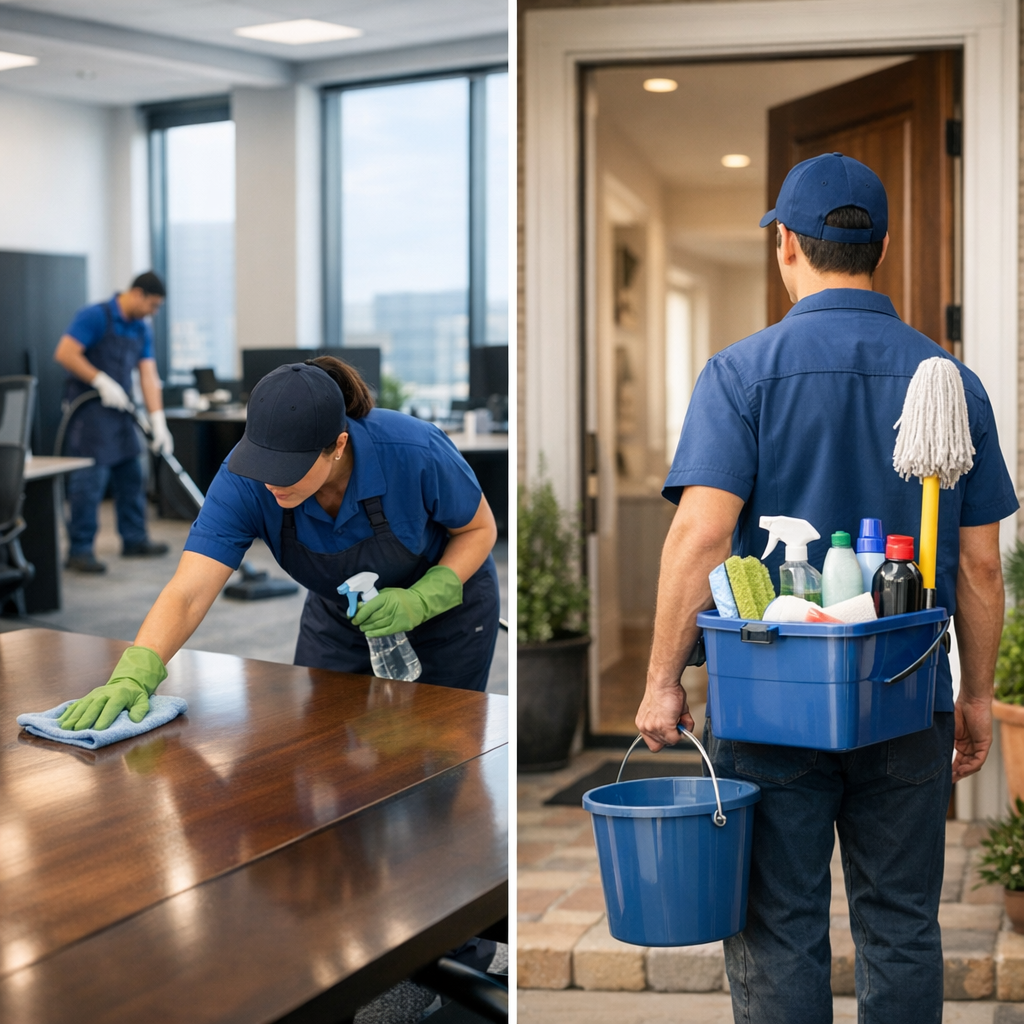
Short answer: For cleaning franchises, office contracts (B2B janitorial) create steadier, compounding recurring revenue and higher business value, while one‑off jobs (carpet cleans, post-construction, move‑outs) add margin spikes and cash flow but are volatile. The strongest operators target 70–85% recurring contract revenue and 15–30% one‑off project work for upsells and seasonality smoothing.
Recurring Revenue in Cleaning Franchises: Office Contracts vs. One-Off Jobs
Quick Answer — Which Model Builds Better Recurring Revenue?
Answer-first: Office contracts win for predictability, capacity planning, and valuation; one-off jobs win for immediate cash and flexible entry. The best-performing cleaning franchisees blend both, using contracts as the backbone and one-offs as strategic boosters.
How Cleaning Franchises Make Money
- Recurring office contracts (B2B janitorial): Nightly or weekly cleaning with 12–36 month terms.
- One-off projects: Carpet/tiles, deep cleans, turnover/make-ready, post-construction, disinfection.
- Add-ons/upsells: Windows, floor care, consumables (paper goods, liners).
- Residential services (optional): Recurring but higher churn; best as a separate team/brand.
Office Contracts vs. One-Off Jobs: Side-by-Side
Answer-first: Contracts drive stable cash and higher exit multiples; one-offs maximize dollars per hour and lower initial capital.
- Revenue predictability: Contracts high; one-offs low.
- Margins: One-offs slightly higher gross (35–55%) vs. contracts (28–45%), but contracts yield steadier net over time.
- Sales cycle: Contracts longer (30–120 days, RFPs); one-offs short (same week to 2 weeks).
- Churn risk: Contracts low-to-medium (5–20% annual); one-offs inherent 100% unless converted.
- Capacity utilization: Contracts smooth schedules; one-offs create peaks/valleys.
- Working capital: Contracts often net‑30/45; one-offs often paid on completion/deposit.
- Staffing: Contracts = stable night crews; one-offs = flexible specialists/floaters.
- Customer acquisition cost (CAC): Contracts higher per account but better LTV/CAC; one-offs lower CAC but limited LTV.
Unit Economics Benchmarks (Field Experience)
Answer-first: Healthy contract-heavy cleaning units commonly hit payback in 6–12 months with disciplined sales and retention.
- Average monthly contract value (SMB): $600–$2,500 per location
- Gross margin: Contracts 28–45%; one-offs 35–55%
- Annual churn (by revenue): 5–20% with strong QA and relationship management
- CAC per contract: $300–$1,200 (mix of outbound, local SEO, referral, brokers)
- Payback period on CAC: 2–6 months for contracts
- Average contract tenure: 18–36 months; extend with renewals and upsells
- Upsell attach rate: 15–35% of contract base buys at least one project per year
Note: Ranges reflect multi-market observations. Validate with the franchisor’s Item 19 and regional peers.
Practical Playbook: Build a Recurring Base and Layer Profitable Jobs
- Define your revenue mix target: 70–85% contracts; 15–30% projects.
- Prioritize ICPs: Medical/dental, property managers, offices 2k–20k sq ft, schools, gyms, light industrial.
- Sales motion: 2–3 daily walk-ins/cold visits, quote within 24 hours, social proof, and verticalized case studies.
- Pricing: Quote by scope and frequency; tie-in quarterly deep cleans or floor care at discounted bundle rates.
- Staffing: Hire night leads early; develop floater bench for call-outs and one-offs.
- Quality and retention: 30/60/90-day check-ins, photo checklists, and client scorecards.
- Tech stack: Routing/timekeeping, CRM, review management, proposal software with e-sign.
- Cash flow: Autopay for contracts; 50% deposit for one-offs; enforce net‑15/30.
- Compliance: Proper insurance, OSHA/JanSan training, background checks for sensitive sites.
Franchise Selection: What to Evaluate
Answer-first: Favor brands with B2B contract expertise, national accounts, strong training, protected territories, and transparent unit economics.
- Does the brand provide national accounts or bid support?
- What’s the average first-year contract count and revenue per owner? See Item 19.
- How are territories defined? Are they protected by number of businesses or population?
- What startup equipment is included? Can you finance via the franchisor?
- What is the lead-gen engine (SEO, PPC, brokers, outbound) and average CAC?
- What is the royalty + ad fund and what support is delivered?
- How many transfers/closures in the last 3 years? Interview current and former franchisees.
New to this process? Read our guide on how to buy a franchise and compare low-cost franchise opportunities if you’re capital-conscious. Shortlist candidates from our best franchises for 2026 list.
Key Risks and How to Mitigate
- Client concentration: Cap any single client at 15% of revenue; diversify sectors.
- Turnover: Pay slightly above market; offer stable shifts and fast dispute resolution.
- Scope creep: Clear SOW with exclusions; change orders for extras.
- Collections: Autopay + late fees; stop-work policies for chronic late payers.
- Quality dips: Regular inspections; coach, don’t just correct.
- Regulatory/compliance: Healthcare/education sites require credentials and documentation.
Valuation Impact: Why Recurring Revenue Commands Higher Multiples
Answer-first: Small service businesses with contract-heavy revenue often trade at ~2.5–4.5x SDE versus ~1.5–2.5x for project-heavy peers, assuming similar size and growth. Lenders also prefer recurring revenue for SBA underwriting.
Tools and Metrics to Track
- MRR by client cohort and net revenue retention
- Churn (logo and revenue) and save rates
- LTV:CAC for contracts vs. one-offs
- Job costing by site and team
- Quality scores, NPS/reviews, referral rate
- Utilization of crews and overtime percentage
Real-World Snapshot: A 12-Month Ramp Plan
- Months 0–3: Hire lead tech + floater; close first 8–12 contracts ($8–15k MRR); 10–15 reviews.
- Months 4–6: Add supervisor; reach $20–30k MRR; book 2–3 one-offs/month; implement QA cadence.
- Months 7–12: $40–60k MRR; 20–30% attach rate on projects; stabilize margins 30–40% gross.
FAQs
What’s the ideal mix of contracts and one-offs? Aim for 70–85% recurring MRR and 15–30% projects for seasonal cash and upsells.
How much capital do I need? Many cleaning franchises fall under “low-cost franchise opportunities,” with total investment often in the $75k–$200k range. Verify current numbers in the FDD.
Residential or commercial? Commercial contracts produce steadier recurring revenue and higher valuations. Residential can work, but expect higher churn and tighter routes.
Next Step: Get Expert Help
Choosing the right brand and territory is half the battle. A seasoned consultant can benchmark unit economics, review FDDs, and negotiate incentives. Professional Franchise Brokers offers no-cost guidance to buyers and shortlists contract-strong cleaning brands.
- Schedule a free consultation with Professional Franchise Brokers
- Explore our Cleaning Franchises industry overview
- Compare candidates on our Best Franchises for 2026 list
Disclaimer: This article is for educational purposes. Always consult the FDD, speak with multiple franchisees, and engage a franchise attorney and CPA before investing.