
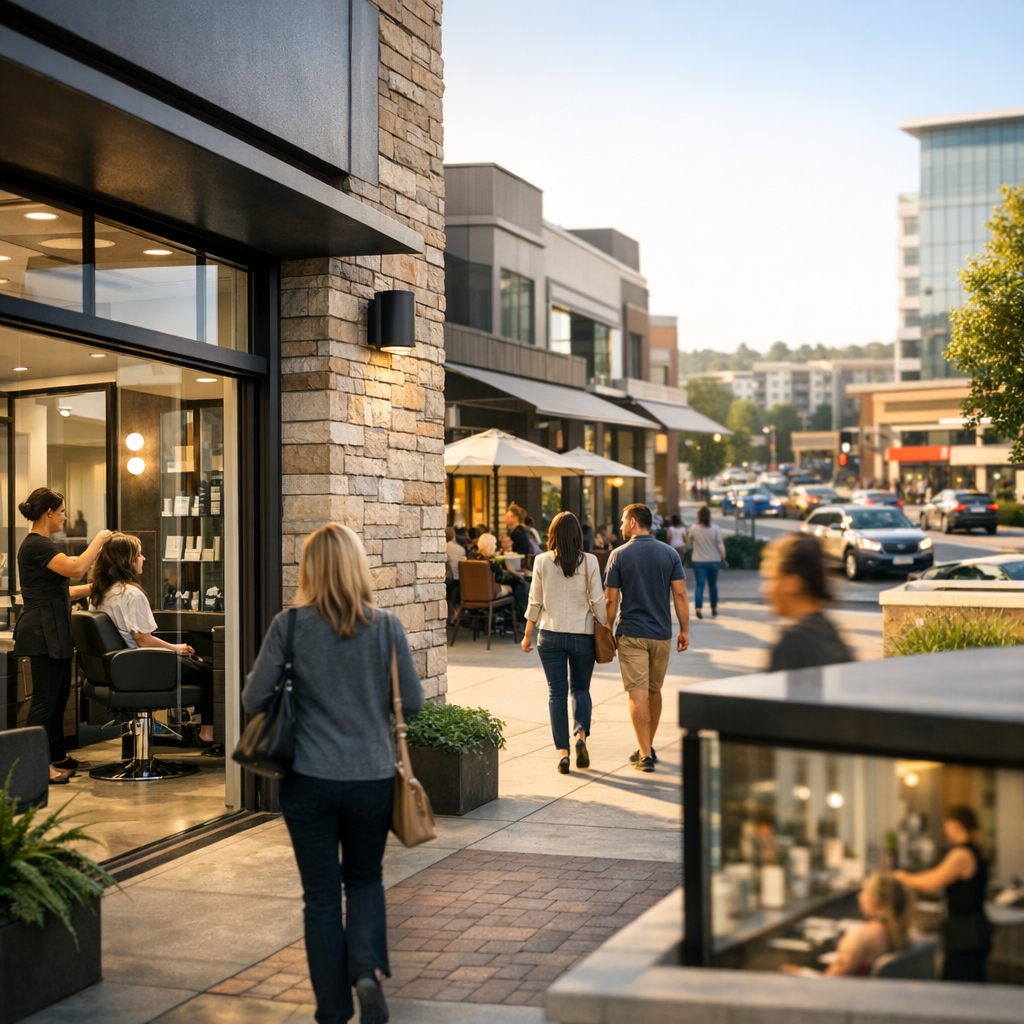
The best salon suite locations combine strong foot traffic, matching demographics, and balanced competitor density. Use objective data, on-site observations, and a simple ROI model to choose sites that lease up quickly, sustain rates, and protect your brand.
Quick answer: How to pick the best salon suite location
Choose sites with daily-needs anchors, affluent and beauty-engaged populations, and limited direct competition within a 10–15 minute drive.
- Target centers anchored by grocery, fitness, and pharmacy to ensure steady, all-week foot traffic.
- Look for median household income above local average, dense daytime population, and high personal-care spend.
- Prefer trade areas with one to two direct suite competitors (not five), healthy demand signals, and room to differentiate.
- Validate with mobile-location data, traffic counts, and on-site visits across multiple dayparts.
- Model rent per square foot, suite count, achievable rates, and break-even occupancy before negotiating LOI.
Foot Traffic: What matters most
Steady, qualified, and convenient traffic beats sheer volume.
- Prioritize daily-needs anchors: grocery (e.g., Kroger, H-E-B), big-box (Target), fitness (Orangetheory), coffee (Starbucks), pharmacy (CVS). These drive repeat visits from your ideal clients.
- Evaluate daypart mix: morning (coffee/fitness), midday (grocery/lunch), and evening (gym/dining). Balanced dayparts support stylist schedules and client preferences.
- Access and convenience:
- Right-in/right-out access from major corridors (AADT > 25,000 where possible).
- Visible pylon or building signage; clear wayfinding to your entrance.
- Parking ratio: aim for 4–5 spaces per 1,000 SF and nearby stalls for quick client turnover.
- How to measure:
- Use mobile-location platforms (e.g., Placer.ai, Near) for monthly visits, dwell time, and cross-shopping with beauty/fitness.
- DOT traffic counts for nearby arterials; confirm no planned road closures limiting access.
- On-site counts: visit three dayparts on a weekday and once on a weekend; note footfall and parking turnover.
Demographics: Who lives, works, and spends nearby
Seek affluent, style-conscious households with high personal-care spend and robust daytime employment.
- Trade area: map a 10–15 minute drive-time (not just a radius) to reflect real behavior.
- Core metrics to target:
- Median household income: at or above market average; many successful suites perform best at $85k+ MHI.
- Population density: 60k–100k+ within 15 minutes often supports fast lease-up (adjust for suburban vs. urban).
- Daytime population: 1.2–1.5x resident base improves midweek booking and retail add-ons.
- Consumer spend: above-average Beauty/Personal Care index (ESRI/Claritas) indicates pricing power.
- Age/psychographics: 25–44 clusters, wellness/fitness enthusiasts, and high salon frequency cohorts.
- Signals from the ground:
- Nearby boutique fitness and premium grocers suggest willingness to pay for convenience and quality.
- Look for salon-adjacent spend: med spa, nail bars, blow-dry bars, and bridal businesses.
Competitor Density: Saturation vs. synergy
One to two direct competitors can validate demand; heavy clusters compress rates and lengthen lease-up.
- Direct competitors: salon suites and booth-rental studios. Secondary: full-service salons, blow-dry bars, barbers, nail lounges, med spas.
- Assess within 10–15 min drive:
- Count competitors, note occupancy, suite sizes, published rates, and waitlists.
- Identify gaps: private entry, 24/7 access, premium finishes, larger esthetics rooms, or better parking.
- Healthy balance looks like:
- Proof of demand: at least one established operator with high occupancy.
- Room to differentiate on amenities, branding, and service to stylists.
- Limited race-to-the-bottom pricing pressure.
Co-tenancy, site fit, and lease economics
Great co-tenancy plus practical build-out wins more than a cheap rent alone.
- Co-tenancy synergies: boutique fitness, specialty grocery, coffee, beauty retail, wedding/bridal, childcare, and medical offices.
- Box and utilities:
- Depth and width that accommodate 20–35 suites; 3–5 esthetics rooms; rough-ins for sinks and laundry.
- Plumbing capacity, sound attenuation, HVAC zoning, and ample electrical panels per suite.
- Grease trap typically not required, but check local code for shampoo bowls and backflow.
- Lease terms to negotiate:
- Free rent through build-out, substantial TI allowance, cap on CAM, and signage rights.
- Use clause flexibility, exclusive for “salon suites,” and co-tenancy or early termination in case anchors leave.
Data sources and a practical due diligence checklist
Blend third-party data with fieldwork to cut through landlord sales talk.
- Market data: ESRI/Claritas (demographics/psychographics), Census ACS, CoStar/Crexi (comps), DOT traffic counts.
- Mobile data: Placer.ai, Near, or Unacast for visits, trade areas, and cross-shopping.
- Fieldwork:
- Walk the center four times (weekday AM, midday, PM, weekend peak).
- Talk to tenants about sales, seasonality, parking, and security.
- Mystery shop competitors; note suite quality, amenities, and service to renters.
- Decision pack:
- Drive-time demographic snapshot, competitor map, rent and TI summary, 24-month lease-up plan, and break-even analysis.
Franchise angle: Territories, validation, and expert guidance
If you’re exploring a salon suite franchise, align territory rights with proven demand and get independent advice.
- Start here: how to buy a franchise to understand FDDs, Item 7/19, and territory protections.
- Explore low-cost franchise opportunities if you’re capital-sensitive; compare TI support and preferred landlord networks.
- Monitor best franchises for 2026 to see which beauty and wellness brands are scaling sustainably.
- Call to action: Work with a seasoned franchise consultant like Professional Franchise Brokers to benchmark brands, negotiate territories, and audit site economics. Book a strategy session at our franchise consulting page.
ROI snapshot: Simple math before you sign
Model conservative occupancy and rates against total occupancy cost.
- Capacity: 30 suites x 85% stabilized occupancy = 25.5 occupied suites.
- Rates: $300/week average x 4.33 = $1,299 monthly per suite → ~$33,145 monthly revenue.
- Costs: Base rent + NNN at $32/SF on 6,000 SF = ~$16,000/month; add utilities, staff, marketing, and reserves.
- Break-even occupancy: Total monthly costs ÷ monthly rate per suite. If costs are $25,000, break-even ~19.2 suites (~64%).
- Sensitivity-test ±10% on rates and lease-up speed; only proceed if margins hold under stress.
Red flags and when to walk away
- Centers with great traffic but poor access (U-turns, no signalized entrance, chronic parking shortages).
- Three or more direct suite competitors within 10 minutes, all discounting rates or offering large concessions.
- Anchors in distress or high vacancy trends; landlords unwilling to provide TI or signage rights.
- Demographics below market income, weak daytime population, or low personal-care spend indexes.
- Landlord prohibits backbar plumbing modifications or imposes restrictive use clauses.
FAQs
What’s a good minimum for traffic and income? Aim for AADT > 25,000 on the nearest arterial, MHI at or above market average, and strong personal-care spend indices.
How far should I space locations? Protect a 10–15 minute drive-time between sites to limit cannibalization; confirm franchise territory rules.
Urban vs. suburban? Urban suites trade rate for smaller footprints and transit access; suburban benefits from parking and daily-needs anchors. Model both with local comps.
Do I need a franchise to succeed? Not necessarily. Franchises can speed vendor access, playbooks, and marketing—evaluate costs in Item 7 and earnings data in Item 19.
Related resources on our site
- Salon Suite Franchise Guide
- Retail Site Selection Checklist
- Franchise Financing Options
- Local Market Research Services
Author’s note: Over the past decade, I’ve evaluated 200+ beauty and wellness sites across urban and suburban markets, with a focus on lease-up speed, rate durability, and suite mix strategy.