
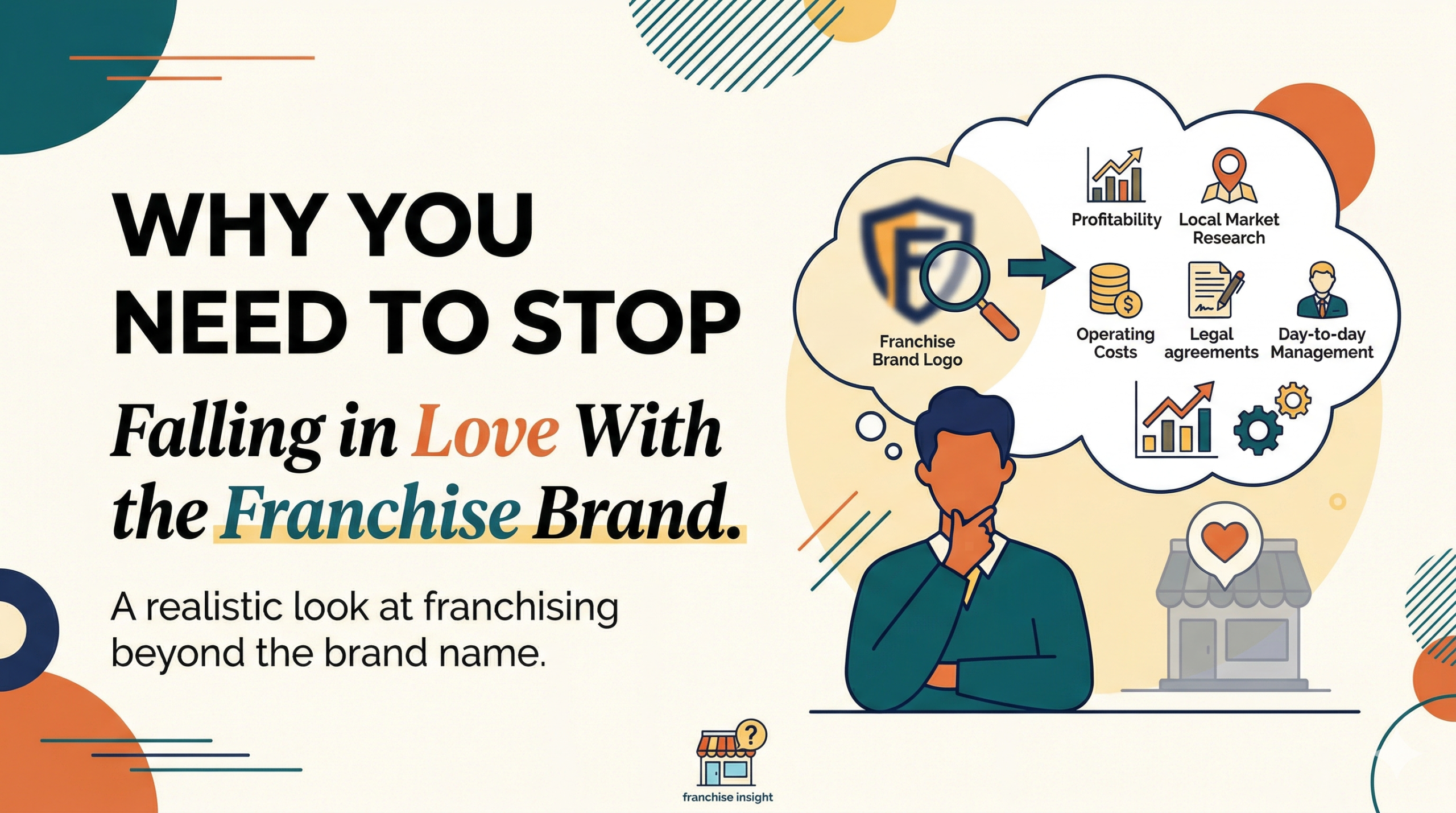
Short answer: Don’t buy a franchise because you love the logo. Buy it because the unit economics, operating model, and support systems make sense for your goals, skills, and capital. This article shows you how to evaluate opportunities objectively—and avoid the most expensive mistake in franchising: brand infatuation.
Why you need to stop falling in love with the franchise brand
Answer-first: A strong brand doesn’t guarantee strong cash flow. Unit-level performance, leadership quality, local demand, and support are what drive returns.
- Brand equity can mask weak Item 19 financials or high failure rates in the FDD.
- National logos rarely fix local realities: labor markets, rents, traffic, and competition.
- Marketing claims don’t equal profitable territory or sustainable margins.
What actually drives franchise success (beyond the logo)
Answer-first: Focus on economics, execution, and fit.
- Unit economics: average revenue, gross margin, controllable expenses, break-even, and cash-on-cash return.
- Leadership and support: CEO/operator pedigree, field coaching ratio, onboarding rigor, playbooks, tech stack.
- Labor model: staffing levels, wage pressure, turnover, training cycle.
- Customer acquisition: lead sources, conversion rates, LTV:CAC, marketing fund transparency.
- Territory quality: demographics, competition saturation, drive times, B2B vs. B2C mix.
- Capex and working capital: buildout, equipment, initial inventory, ramp time to break-even.
- Royalty and fees: effective take rate vs. system value; ad fund usage and auditing.
How to buy a franchise without brand bias
Answer-first: Use a disciplined, step-by-step process that quantifies risk and return.
- Define your goal: income replacement, multi-unit scale, semi-absentee, or asset build.
- Set a budget: liquid capital, net worth, and tolerance for debt (SBA 7(a), 504, or ROBS).
- Build a short list from data, not ads. Start with categories that fit your skills and hours.
- Screen the FDD: litigation, closures/transfers, Item 19 quality, ad fund accountability.
- Validate with 6–10 owners across markets; ask about ramp, margins, churn, and support follow-through.
- Model unit economics: conservative, base, and upside cases with payback and sensitivity to key costs.
- Score the operator burden: staffing complexity, licensing, seasonality, hours, and your role.
- Stress-test territory: demographic fit, anchor tenants, competitors, drive-time mapping.
- Negotiate timeline and support: site selection SLAs, training seats, opening support, first-year coaching cadence.
- Have counsel review the FDD and agreements; align financing and working capital before signing.
Metrics to compare before you commit
Answer-first: Use apples-to-apples KPIs to compare brands.
- Median revenue per unit and per territory (not just averages)
- Four-wall EBITDA and contribution margin
- Owner hours per week and manager-to-staff ratio
- Customer acquisition cost and payback period
- Lease economics: occupancy cost as % of sales
- Buildout cost variance and ramp-to-break-even
- Churn and resale multiples on transfers
Red flags when “brand” is the primary pitch
Answer-first: When sizzle replaces data, walk away.
- Thin or non-existent Item 19 or wide ranges with no context
- Heavy emphasis on influencers or PR instead of owner ROI
- Pressure tactics: discounts “ending Friday,” rushed discovery days
- Ad fund opacity or refusal to provide campaign performance
- High transfer activity without clear cause analysis
Low-cost franchise opportunities: where value hides
Answer-first: Low investment doesn’t mean low upside—if the model scales with modest capex and disciplined marketing.
- Service brands (home services, B2B maintenance) with mobile or home-based models
- Training/education, niche fitness with low fixed costs
- Emerging concepts with strong validation and experienced leadership
Explore our guide to low-cost franchise opportunities for categories, investment ranges, and due-diligence checklists.
Best franchises for 2026: choose by criteria, not hype
Answer-first: The “best franchises for 2026” share durable demand, efficient labor, and resilient unit economics.
- Recurring revenue or frequent repeat purchase
- High margin after royalties and marketing fees
- Simple operations with strong playbooks and tech enablement
- Clear territory strategy and white-space availability
- Management experience with prior scale outcomes
See our data-backed shortlist in best franchises for 2026.
Case study: beating the brand bias
Answer-first: One candidate chose a lesser-known home services concept over a national F&B brand—and hit break-even in four months due to lower capex, flexible staffing, and high-margin jobs. The lesson: chase margins, not mascots.
Work with a franchise consultant (save time, avoid mistakes)
Answer-first: A seasoned consultant keeps you objective, curates fits, and pressure-tests the numbers.
- Curated matches based on capital, skills, and role preference
- FDD screening, validation question sets, and territory vetting
- Financial modeling and lender introductions
- Opening plan and first-year KPI dashboard
Schedule a no-pressure call with Professional Franchise Brokers to get a custom shortlist and a due-diligence roadmap.
Related resources
- How to Buy a Franchise: Complete Step-by-Step Guide
- Franchise Financing: SBA loans, ROBS, and Alternatives
- Understanding FDD Item 19 and Unit Economics
- Franchise Territory Analysis: Data and Tools
FAQ
Answer-first: Quick answers you can act on.
- Why is brand love risky? Because it leads to shortcuts—skipping FDD analysis, validation, and real modeling—often resulting in poor unit economics.
- How do I start if I’m new? Read our how to buy a franchise guide, define goals/budget, then book a consult.
- Are low-cost franchises worth it? Yes, when margins, CAC, and owner time are favorable. See low-cost franchise opportunities.
- What are the best franchises for 2026? Concepts with recurring revenue, strong Item 19s, and simple operations. Start with our best franchises for 2026 list.
Disclaimer: This article is for educational purposes only and is not legal, tax, or investment advice. Always consult qualified professionals and review the FDD with counsel.