
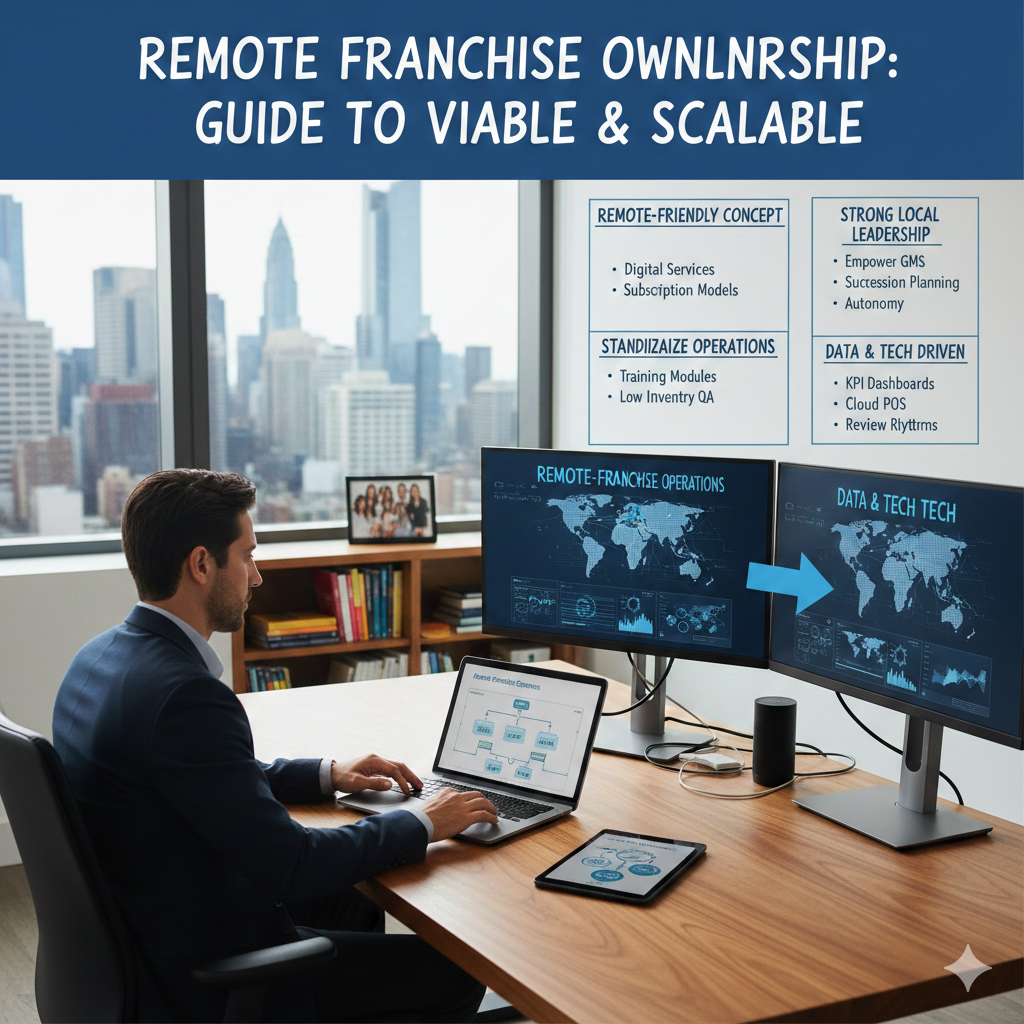
Yes—managing a franchise business remotely is possible if you select a remote-friendly concept, install strong local leadership, standardize operations, and run the business with data, technology, and disciplined review rhythms. Below is a practical, answer-first guide to make remote franchise ownership viable and scalable.
Quick Answer: Can You Run a Franchise Remotely?
Yes, but only with the right model and controls. Remote management works when you: (1) choose a franchise designed for semi-absentee/remote oversight, (2) implement a rigorous operating system, (3) invest in training and local leadership, and (4) manage by metrics, not proximity.
- Pick brands that support semi-absentee ownership (ask for proof and references).
- Install a reliable on-site manager and cross-train backups.
- Use a unified tech stack for POS, scheduling, inventory, and QA.
- Hold weekly performance reviews with a standard scorecard.
- Audit quality, compliance, and customer experience monthly.
What Makes a Franchise “Remote-Ready”?
Look for concepts engineered for operational consistency at a distance.
- Documented SOPs with video-based training and certification paths.
- Centralized procurement and supply chain with tight vendor SLAs.
- Cloud-based POS, scheduling, payroll, and inventory with real-time data.
- Field support (coaching, mystery shops, brand audits, marketing playbooks).
- Simple labor model (lean headcount) and minimal technical complexity.
- Proven success stories from remote or semi-absentee owners you can call.
Step-by-Step: How to Manage a Franchise Remotely
- Choose the right concept. Target industries with predictable operations (home services, simple food, fitness, B2B services). Evaluate our guides on how to buy a franchise, low-cost franchise opportunities, and the best franchises for 2026.
- Validate remote feasibility. In Item 19 (FDD), scrutinize unit economics; call franchisees who run remotely; confirm staffing assumptions and owner time commitments.
- Hire and empower a competent local manager. Define KPIs, decision rights, and bonus plan aligned to profit and customer satisfaction.
- Implement your tech stack. POS, time and attendance, inventory controls, CRM, task management, QA checklists, BI dashboards. Require daily closeouts and exception reports.
- Build a scorecard (manage by numbers). Review revenue, labor %, COGS, customer NPS, ticket averages, and lead conversion weekly.
- Set operating rhythms. Daily open/close checklists; weekly 45-minute KPI review; monthly audit; quarterly strategic review.
- Tighten cash and compliance controls. Bank feeds, role-based access, surprise inventory counts, video verification for cash handling (if applicable).
- Engineer customer experience. Standard greetings, service scripts, upsell prompts, and service recovery playbooks. Monitor reviews and respond within 24 hours.
- Scale responsibly. Add a second unit only after 90 days of consistent KPI performance and clean audits; then layer an area manager or lead operator.
Essential Tools for Remote Operations
Pick integrated, cloud-first tools with role-based permissions and alerts.
- POS and payment: centralized pricing, discounts, and end-of-day variance reports.
- Workforce: scheduling, time clocks (GPS/biometric), labor forecasting.
- Inventory: PAR levels, automated reorders, shrink alerts, vendor reconciliation.
- CRM/marketing: lead capture, drip campaigns, review management, LTV tracking.
- Task/QA: daily checklists, photo verification, audit templates, corrective actions.
- BI dashboards: real-time KPIs, cohort comparisons, heatmaps, exception alerts.
- Security: cameras, access control logs, data backups, and SOC 2/PCI awareness.
Your Remote KPI Scorecard (Weekly)
Measure what you can act on immediately.
- Revenue drivers: tickets per day, average ticket, new vs. repeat mix, lead conversion.
- Unit economics: labor %, COGS %, gross margin, controllable EBITDA.
- Capacity and utilization: appointments filled, class or bay utilization, dwell time.
- Customer experience: NPS, review velocity and star rating, refunds/complaints.
- Quality and compliance: audit pass rate, checklist completion, incident reports.
- Cash integrity: voids, discounts, refunds, deposit variance (with camera spot-checks).
Remote vs. Absentee vs. Semi-Absentee
Define your operating posture clearly.
- Remote owner-operator: Offsite most days but active in decisions and reviews (5–20 hours/week).
- Semi-absentee: Strategic oversight with a strong GM and area lead (5–10 hours/week per unit).
- Absentee: Minimal involvement; usually not advisable unless brand explicitly supports it with field ops and a trusted operating partner.
Compliance and Risk You Must Manage
Distance increases risk—counter it with structure.
- FDD adherence and brand standards; document exceptions and corrective actions.
- Labor law compliance: scheduling, breaks, overtime, I-9, wage statements.
- Licensing and insurance: general liability, workers’ comp, cyber/data riders.
- Data security: PCI for payments, PII handling, device hardening, MFA.
- Financial controls: segregation of duties, approval thresholds, audit trails.
Common Pitfalls (and How to Avoid Them)
Most failures stem from weak management cadence and unclear accountability.
- “Set-and-forget” ownership → Establish weekly reviews and monthly audits.
- Underestimating manager quality → Hire slow, test for judgment, bonus on EBIT and NPS.
- Fragmented tech → Standardize on one stack; eliminate manual spreadsheets.
- No cash or inventory controls → Daily variance reports and surprise counts.
- Ignoring reviews → Respond within 24 hours; treat patterns as training signals.
Costs, Time, and ROI Expectations
Remote readiness adds upfront cost but protects margins.
- Incremental costs: stronger GM compensation, software subscriptions, cameras, audits.
- Time: expect 5–15 hours/week per unit at launch; 3–8 once stable.
- ROI: hinges on labor and COGS control, lead generation efficiency, and manager quality more than your physical presence.
Related Guides to Build Topical Authority
- How to Buy a Franchise: Due Diligence to Day 1
- Low-Cost Franchise Opportunities: Entry Points and Trade-Offs
- Best Franchises for 2026: Sectors to Watch
- Franchise Due Diligence Checklist (Free Download)
FAQs
Can I run a franchise from another state? Yes, if the brand supports semi-absentee ownership, you have a capable GM, and you enforce KPI and audit rhythms.
How many hours per week will I need? Launch: 10–20 hours/week per unit. Steady state: 3–8 hours, assuming a strong manager and clean KPIs.
Are low-cost franchises viable remotely? Often, yes—especially home services and simple service models. Validate staffing needs and dispatch/logistics. See low-cost franchise opportunities.
What industries work best? Home services, B2B services, fitness studios with strong SOPs, and limited-menu food with centralized prep tend to be more remote-friendly.
How do I finance a remote-run franchise? Consider SBA 7(a), ROBS, seller financing, or portfolio LOCs. Lenders will scrutinize your operator plan and manager resume.
Next Steps
Get matched to remote-ready franchises—and avoid costly missteps. Book a no-obligation call with Professional Franchise Brokers to shortlist concepts, validate remote feasibility with real owners, and pressure-test your operating model. Prefer to research first? Start with our guides on how to buy a franchise and the best franchises for 2026.
Editorial note: This guide synthesizes established franchise operations practices, FDD review norms, and field-audit checklists commonly used by multi-unit operators. Always consult your attorney and accountant before investing.