
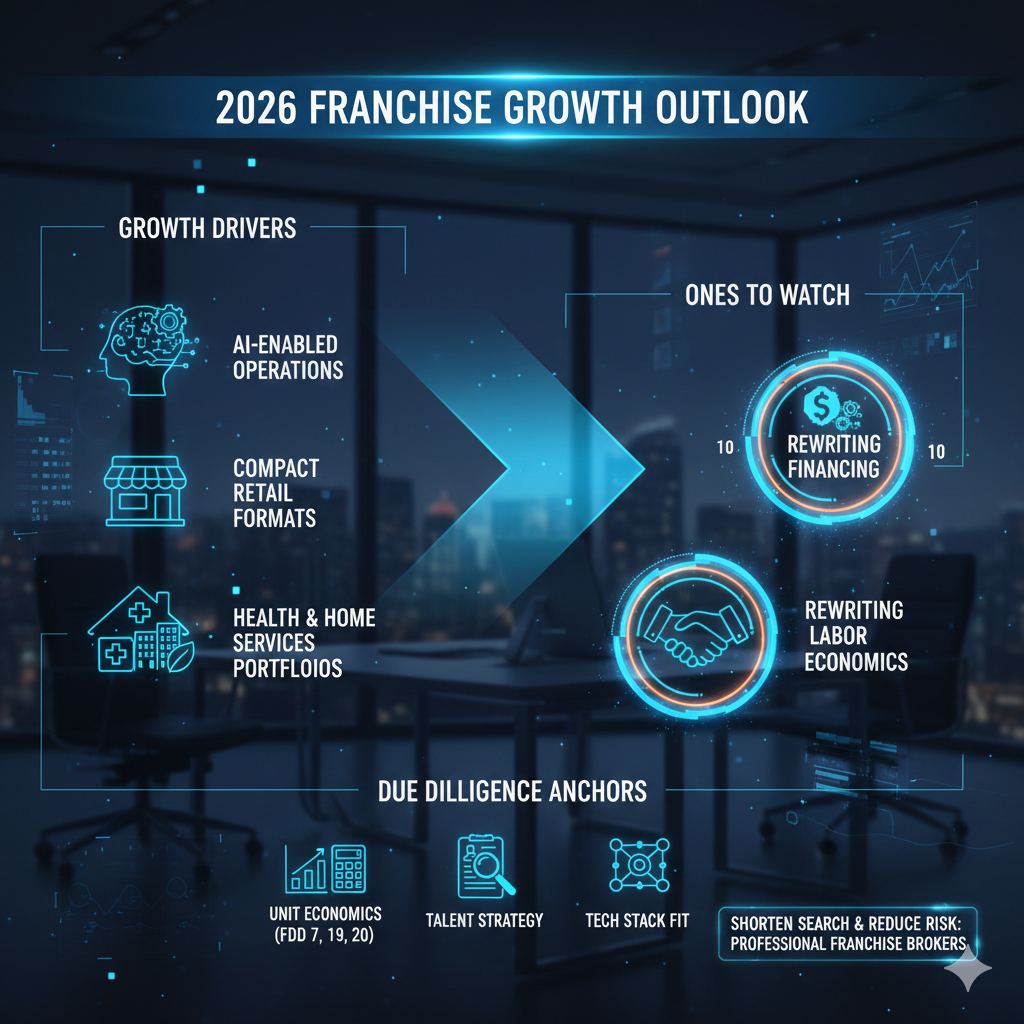
Here’s what matters most: 2026 franchise growth will be led by AI-enabled operations, compact retail formats, health and home-service demand, and multi-unit portfolio strategies—while two “ones to watch” (#5 and #10) could rewrite financing and labor economics for emerging brands. If you’re evaluating the best franchises for 2026, anchor your due diligence in unit economics (FDD Items 7, 19, 20), talent strategy, and tech stack fit—and consider using a trusted franchise consultant like Professional Franchise Brokers to shorten your search and reduce risk.
At-a-glance answer
- AI “copilots,” automation, and data interoperability will raise franchisee margins and simplify multi-unit oversight.
- Micro-footprints, kiosks, and flexible formats win in high-cost markets.
- Health, wellness, and home services remain resilient as consumers seek convenience and outcomes.
- Private-equity-backed multi-brand portfolios keep consolidating prime territories.
- #5 (Ones to Watch): Community and crowd-investing models could expand access to capital—but require careful compliance.
- #10 (Ones to Watch): Robotics-first brands show promise in labor-tight segments but bring capex and regulatory hurdles.
The Top 10 Franchise Trends That Will Define 2026
-
AI-enabled operations and decision support
Bottom line: Brands that embed AI into scheduling, pricing, marketing, and inventory will out-execute peers and lift store-level EBITDA.
- AI “copilots” help franchisees forecast demand, optimize labor, and personalize local marketing.
- Expect franchisors to standardize data pipelines that feed dashboards for multi-unit operators.
- What to check in the FDD: training scope, approved vendor lists, and data ownership policies.
Next step: compare tech stacks when researching the best franchises for 2026.
-
Micro-footprints and flexible retail formats
Bottom line: Smaller footprints, kiosks, and co-tenancy reduce buildout costs and speed openings.
- Modular designs and drive-thru/pickup-first layouts improve throughput and site availability.
- Look for brands with playbooks for conversions and second-generation spaces.
- What to check: Item 7 buildout ranges, landlord incentives, and fixture standardization.
-
Health, wellness, and outcomes-focused services
Bottom line: Preventive care, recovery, and performance niches expand—compliance and credentialing matter.
- Recovery studios, PT/OT-adjacent services, and women’s health concepts are scaling.
- Scrutinize clinical protocols, state scope-of-practice rules, and medical director requirements.
- What to check: insurance/billing exposure, staffing model, and recurring revenue mix.
-
Home services remain resilient
Bottom line: Aging housing stock and “stay-and-improve” behavior sustain demand across cleaning, restoration, and trades.
- Low cyclicality and simpler buildouts favor first-time owners exploring low-cost franchise opportunities.
- Route density, territory mapping, and lead-gen systems are the difference-makers.
- What to check: average ticket, repeat rate, and crew utilization assumptions in Item 19.
-
Community finance and crowd-investing models (One to Watch)
Bottom line: Reg CF/Reg A-style equity raises and revenue-share notes could open locations faster—but add securities-compliance complexity.
- Local investors become brand advocates, improving launch marketing and loyalty.
- Structures vary: SPVs for single-unit ownership, revenue shares, or community funds.
- What to check: franchisor approval policies, ongoing investor relations burden, and dilution math.
Tip: Engage counsel early and consider a consultant like Professional Franchise Brokers to pressure-test the capital stack.
-
Sustainability and compliance as operating discipline
Bottom line: Energy-efficient equipment, waste tracking, and supplier disclosures reduce costs and help win enterprise accounts.
- Facilities with smart meters, LED, and heat-pump retrofits can cut utilities 10–30% over time.
- B2B brands see RFP advantages with documented ESG and safety programs.
- What to check: approved vendors, rebate programs, and training on compliance workflows.
-
Nearshoring and supply-chain resilience
Bottom line: Franchisors are reworking procurement to stabilize COGS and shorten lead times.
- Domestic or nearshore manufacturing of key SKUs and fixtures reduces disruption risk.
- Watch freight surcharges and price-adjustment clauses in supplier agreements.
- What to check: substitution policies and inventory buffers in the ops manual.
-
Open, interoperable franchise tech stacks
Bottom line: APIs and data standards let franchisees unify POS, CRM, ads, and payroll—critical for multi-unit efficiency.
- Beware vendor lock-in; prioritize brands with integration roadmaps and data portability.
- What to check: integration partners, data SLAs, and per-location tech fees.
-
Multi-unit, multi-brand portfolios keep consolidating
Bottom line: Experienced operators and PE-backed platforms are locking up prime territories and professionalizing ops.
- Territory scarcity raises the bar for “owner-operator” paths—apply early and be capital-ready.
- What to check: development schedule realism, area rep support, and transfer policies.
New to due diligence? Start with our guide on how to buy a franchise.
-
Robotics-first and autonomous operations (One to Watch)
Bottom line: Automated kitchens, floor-care robots, and autonomous inventory systems can offset labor constraints—but require capex and careful ROI modeling.
- Most viable in repetitive, safety-critical, or high-throughput environments (QSR, facilities, logistics).
- Factor service contracts, redundancy plans, and local regulatory acceptance into your model.
- What to check: uptime SLAs, financing options, and unit-level payback periods in Item 19 addenda.
What this means for buyers in 2026
- Prioritize brands with strong Item 19 transparency and a path to positive cash flow within 12–18 months.
- Model higher-for-longer borrowing costs; compare SBA 7(a) and ROBS/HELOC mixes, and stress-test DSCR.
- Validate with 8–12 existing franchisees: ask about labor, lead-gen, and real buildout vs. Item 7 estimates.
- If you’re capital-constrained, shortlist low-cost franchise opportunities in home and mobile services.
- For scale-minded operators, target brands with multi-unit development rights and proven area support.
Keyword hub: connect your research
- How to buy a franchise: step-by-step due diligence, FDD walkthroughs, financing options.
- Low-cost franchise opportunities: service concepts under common investment thresholds.
- Best franchises for 2026: performance, support, and scalability lenses.
Due diligence checklist (use this with every brand)
- Unit economics: Item 19 quality, ramp assumptions, sensitivity to labor and COGS.
- Capital plan: Item 7 vs. actuals, contingency buffer, lending pre-qualification.
- Territory: mapping logic, saturation risk, and encroachment policies.
- Support: onboarding timeline, field coaching ratios, marketing co-op transparency.
- Technology: integrations, data ownership, and per-location fees.
- Exit: transfer fees, ROFR terms, historical resale multiples.
Get expert help
Working with a seasoned consultant like Professional Franchise Brokers can save months of research, surface off-market deals, and negotiate better terms. Book a no-obligation call:
- Schedule a franchise consultation
- Contact us with your target investment range and timeline
Author’s note on methodology
These trends synthesize FDD analyses (Items 7, 19, 20), multi-unit operator interviews, SBA lending patterns, and vendor roadmaps across restaurant, fitness, and home-service categories. Always validate assumptions with current franchisees and qualified advisors. This content is for education only and is not financial or legal advice.